What is a COI, and why does it say ACORD?
A certificate of insurance, or COI, summarizes information about your insurance policies so you can share it with someone who asks for proof of coverage. The ACORD name identifies the standardized form; the insurer fields identify the companies providing the listed coverage. Your policy contains the terms that determine coverage; the certificate does not create or change them. 23
A new client says, “Before you start, please send your COI.” You open your insurance documents and find a page with several company names, dates, boxes and dollar amounts. Which name is yours? Which company provides the insurance? And is this the document your client needs?
Here is a practical way to read it.
Why a client asks for a certificate
A client, landlord or business partner may want evidence of your insurance before work begins or an agreement moves forward. A certificate gives them a compact summary to review. A commonly used liability certificate is the ACORD 25. 1
Imagine you run a small design studio. A client hires you to help plan an office refresh and asks for a certificate before your team visits. Start by forwarding the actual request to your insurance agent. That is more useful than guessing which document or wording will satisfy it.
If the request refers to insurance requirements in your contract, include those pages too. You want the agent to see what the client is asking for, not just the sentence “Please send insurance.”
ACORD, your agent and your insurer have different roles
Think of the names on the document as signposts:
- ACORD supplies forms used in insurance. Its name identifies the form provider, rather than the insurer listed on this certificate. 23
- The producer is the agency or broker identified on the certificate. This is a useful starting point for questions about the document. 3
- The insurer is the insurance company listed for a particular policy. A certificate can list several insurers because different companies may provide different coverages. 3
An “ACORD form” is a broader description than a COI. ACORD’s form collection includes different documents for different purposes. Ask for the document’s name or number when a request is unclear. 2
Explore an actual ACORD 25 form
Use the interactive guide below to explore a blank ACORD 25, edition 2025/12. Select a section to see what it means, what information belongs there and what to check. The form is a specimen hosted by the New York Department of Financial Services. It is not an issued certificate or proof of insurance. 3
A closer look at ACORD 25
Blank specimen · 2025/12 editionSelect a numbered area or choose a section. See where it appears, what belongs there and what to check.
The form and complete text guide are available below. Enable JavaScript for selectable callouts.
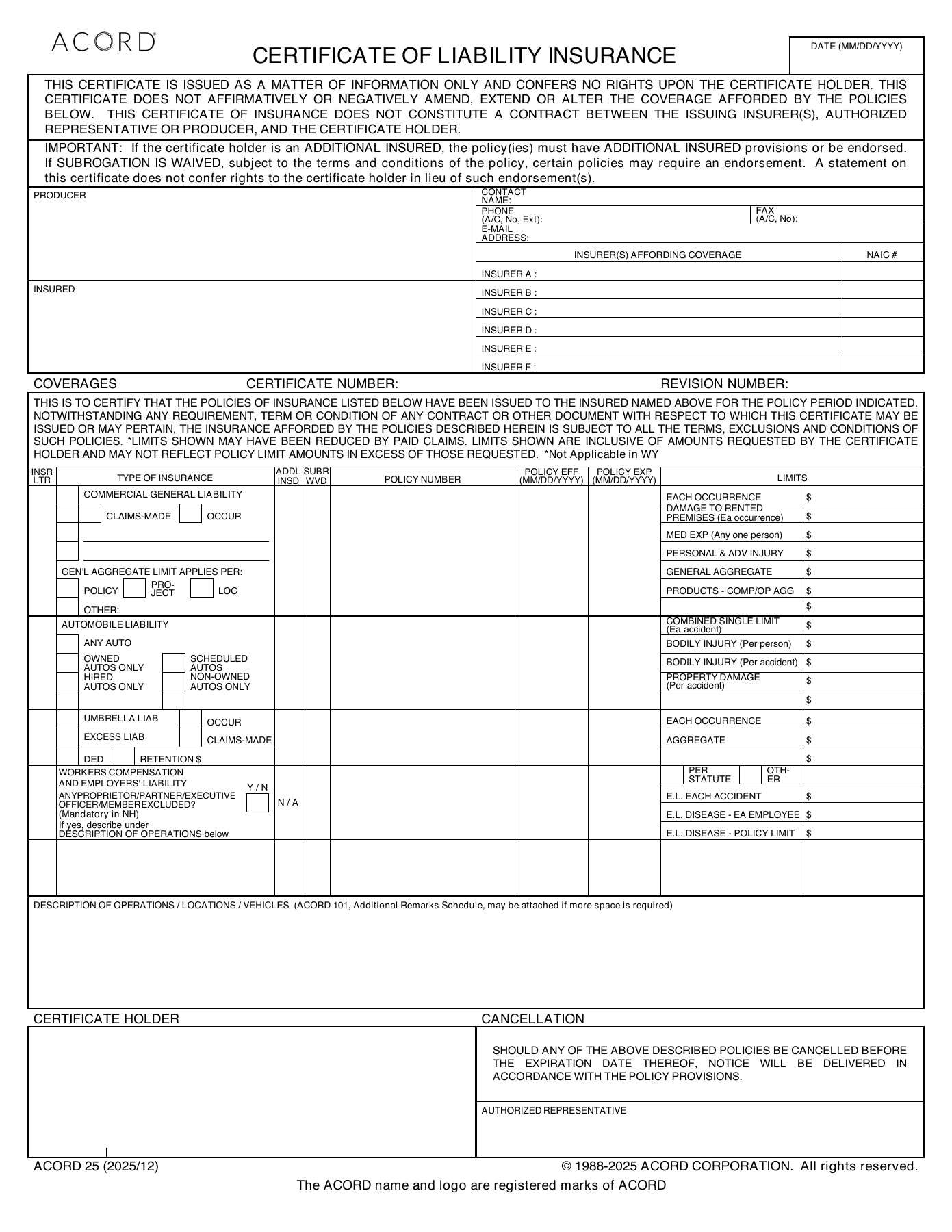
Actual ACORD 25 specimen from the New York Department of Financial Services. Blank and shown for explanation; not proof of anyone’s insurance. © 1988–2025 ACORD Corporation. Form image unchanged; callouts are separate.
Open full-size form ↗Read all 18 section explanations
1. Form name and issue date
What it means: The heading identifies the document; the date is when the certificate is issued.
What belongs here: A certificate issue date entered by the issuer. The ACORD name identifies the form organization, not the insurer.
What to check: The issue date is different from the policy effective and expiration dates.
Example: An issue date can be later than the policy start date.
2. What the certificate can tell you
What it means: These notices explain the certificate’s role as information about policies.
What belongs here: Standard notice wording, including the distinction between a certificate and policy rights.
What to check: The certificate does not change coverage. Additional-insured protection and any waiver must be supported by the policy.
Example: If a client asks for additional-insured status, ask which policy provision or endorsement supports it.
3. Producer and contact
What it means: The producer is the agency or broker associated with the certificate. The contact fields identify whom to ask about it.
What belongs here: Agency name and address, plus the contact name, telephone number and email address.
What to check: Use this contact for document corrections or clarification. Do not mistake the producer for the insurance company.
Example: A fictional entry might read “Example Agency,” with its business address and service contact.
4. Insured business
What it means: This identifies the insured business shown on the certificate.
What belongs here: The insured’s name and address, consistent with the relevant policy records.
What to check: Check the legal entity doing the work. A different company name deserves a question, even if the owner is the same.
Example: “Example Design LLC” should not be casually substituted for a separate company owned by the same person.
5. Insurers and NAIC numbers
What it means: This list identifies the companies providing the listed insurance. Letters connect these entries to the coverage rows.
What belongs here: Insurer names and identifying NAIC company numbers where applicable, assigned to A, B, C and so on.
What to check: Match the insurer letter on each coverage row with this list. Different policies can have different insurers.
Example: An “A” in a coverage row points to the company listed as Insurer A.
6. Certificate references and coverage notice
What it means: Certificate and revision numbers help identify the document. The notice explains how the summary relates to the policies.
What belongs here: Issuer-assigned reference numbers where used, followed by standard explanatory wording.
What to check: This edition’s notice says the certificate may not show policy limit amounts above those requested by the certificate holder. Confirm the full policy limits and any remaining aggregate with the issuer; the printed figures alone do not answer both questions. Applicable state law governs what the issuer may show.
Example: A revised certificate may have a new revision reference; that alone does not mean the policy changed.
Wyoming exception
For property, operations or risks in Wyoming, listed coverage and limits must accurately reflect the policy under W.S. 26-13-125(f)–(g). The form’s Wyoming exception does not mean paid claims cannot reduce the available aggregate. Have the issuer confirm the figures; do not edit them yourself.
Sources: ACORD 25 specimen · Wyoming §26-13-125
7. General liability row
What it means: This is the space for commercial general liability information and its coverage-basis indicators.
What belongs here: The applicable coverage selections, including claims-made or occurrence and the indicated aggregate arrangement.
What to check: Boxes should reflect the actual policy. A contract requesting a per-project aggregate does not create one.
Example: Ask your agent to explain a checked “PROJECT” or “LOC” box and the policy wording supporting it.
8. Automobile liability row
What it means: This row identifies the automobile liability coverage being summarized.
What belongs here: The applicable vehicle categories and policy information, with corresponding limits at the right.
What to check: Owned, hired and non-owned vehicles are different categories. Do not assume an unselected category is insured.
Example: If employees use their own cars for work, ask how non-owned auto liability is addressed.
9. Umbrella or excess row
What it means: This row summarizes an additional liability layer and identifies it as umbrella or excess.
What belongs here: The applicable coverage type, occurrence or claims-made indicator, and deductible or retention information where relevant.
What to check: The name and dollar amount alone do not establish which underlying policies or claims the layer covers.
Example: Ask which underlying policies are scheduled and what must happen before this layer responds.
10. Workers’ compensation and employers’ liability
What it means: This row records workers’ compensation and employers’ liability information, including any indicated owner or officer exclusion.
What belongs here: Applicable coverage indicators, policy details and the answer to whether any proprietor, partner, executive officer or member is excluded. If the answer is yes, the form directs the issuer to describe the exclusion under Description of Operations below. Employers’ liability amounts appear separately in the limits column.
What to check: “Mandatory in NH” concerns reporting the exclusion information in this field; it does not mean every owner or officer must be excluded. Confirm the actual exclusion and applicable state requirements with the issuer. New Hampshire’s rules provide for specified exclusion elections and filings, rather than blanket exclusion of every owner.
Example: Ask whether the listed owner/officer status matches the business and the applicable state rules.
Sources: ACORD 25 specimen · NH Lab 300 rules
11. Other coverage
What it means: The unlabeled row provides space to identify another coverage being summarized.
What belongs here: A clear coverage description and the associated insurer, policy dates and limits as applicable.
What to check: A blank space is not a complete list of what the business does or does not carry. Ask if a requested policy is omitted.
Example: If a client requests professional liability, ask where that policy is shown and what evidence is needed.
12. Insurer letter and status indicators
What it means: These columns connect coverage to an insurer and indicate additional-insured or waiver-of-subrogation information.
What belongs here: An insurer letter and applicable status indicators consistent with the policy.
What to check: A mark does not replace policy terms or an endorsement. A waiver concerns an insurer’s recovery rights and needs its own review.
Example: Ask: “What provision supports the additional-insured or waiver indication for this request?”
13. Policy numbers and dates
What it means: These columns identify each policy and its listed effective and expiration dates.
What belongs here: The issued policy number and the dates for that specific coverage row.
What to check: Read across the correct row. Do not assume every policy has the same renewal date or remains active just because a date is printed.
Example: A project crossing a renewal date may need updated evidence of coverage.
14. Limits
What it means: The dollar amounts belong to specific labels, such as each occurrence, general aggregate or each accident.
What belongs here: The applicable amounts beside their correct labels and any statutory indicator used for workers’ compensation.
What to check: Read each amount beside its limit label. The certificate may omit higher policy limits under this edition’s notice; it is not a running record of the remaining aggregate. Do not add the amounts together or assume the biggest amount applies to every loss. Confirm full limits and remaining availability with the issuer; see section 6 for the Wyoming exception.
Example: Our separate limits article explains why $1 million each occurrence and $2 million aggregate answer different questions.
Sources: ACORD 25 specimen · Wyoming §26-13-125
15. Operations, locations and vehicles
What it means: This area supplies context for the certificate and can refer to additional information.
What belongs here: Relevant operations, locations, vehicles or remarks supported by the underlying policies. An ACORD 101 may provide extra space.
What to check: Remarks cannot create coverage that the policy does not provide. Send the actual client request to the issuer.
Example: The issuer might identify the project location or reference applicable endorsement information.
16. Certificate holder
What it means: This identifies the person or organization receiving the certificate.
What belongs here: The requested recipient’s correct legal name and mailing address.
What to check: Being the certificate holder does not itself make that recipient an insured under the policy.
Example: A client can receive your certificate without receiving additional-insured protection.
17. Cancellation
What it means: This wording addresses notice if a listed policy is cancelled before its stated expiration.
What belongs here: The form’s cancellation statement; any actual notice obligation must be checked against the policy and applicable law.
What to check: Certificate-holder status alone does not guarantee that the recipient will receive cancellation notice. Have the issuer confirm who is entitled to notice, what triggers it and the required timing under the policy, endorsements and applicable law. Do not assume an automatic 30-day promise; the certificate cannot add notice rights.
Example: If a client requests 30 days’ notice, ask the issuer to confirm whether that client has notice rights and what policy, endorsement or applicable law supports the requested trigger and timing.
State-specific notice rules
Texas DOI FAQ 5 addresses recipient and policy/law requirements for Texas risks. Wyoming §26-13-125(j) ties notice entitlement and timing to policy or endorsement rights. These are state-specific rules, not one national notice test.
Sources: ACORD 25 specimen · Texas DOI FAQ 5 · Wyoming §26-13-125
18. Authorized representative
What it means: This is the space for the issuer’s authorized representative.
What belongs here: The authorized signature or representation used by the issuer.
What to check: Have the agency or insurer issue and correct the certificate. A business owner should not sign or alter it to satisfy a request.
Example: If a name, date or limit is wrong, ask for a corrected certificate rather than editing the file.
Start with the insured business and producer, then match each coverage row to its insurer, policy dates and limit labels. Keep the client’s request beside you and note anything you cannot match. The issuer should complete or correct the certificate; this guide helps you read it and ask informed questions.
This edition’s notice means the certificate may not reveal every higher policy limit or the remaining aggregate. Confirm both with the issuer. For Wyoming risks, listed coverage and limits must accurately reflect the policy; the form’s Wyoming exception does not mean claims cannot reduce the available aggregate. 35
Does receiving a COI make my client insured?
Being a certificate holder and being an additional insured are different things. A certificate can communicate policy information, but additional-insured protection must come from the policy and any applicable endorsement, which is a document that changes its terms. 3
If your client asks to be an additional insured, pass along the exact wording. Ask what the policy provides and whether an endorsement is needed. Do not treat adding a name to a certificate as confirmation that the coverage request has been met.
What if the certificate does not match the request?
Separate two questions: “Is the certificate accurate?” and “Does the policy provide what the client requested?”
For a typo, ask the issuer for a corrected certificate. For a different limit, coverage or endorsement, ask the agent to review the requirement against the policy. Changing the summary does not change the underlying insurance. Certificate-holder status alone does not guarantee cancellation notice. Have the issuer confirm the recipient’s notice rights, the triggering event and timing under the policy, endorsements and applicable law. The certificate cannot add notice rights. Texas and Wyoming have their own notice provisions; neither state’s test should be treated as a national rule. 345
What to send your agent
For the design-studio example, a useful request would gather:
- The client’s exact certificate instructions and relevant contract pages.
- The recipient’s legal name, address and delivery contact.
- A short description of the work, its location and expected dates.
- The deadline and any requested additional-insured wording.
Finish with one question: “Can you confirm what our current policies support, and flag anything we need to address before work starts?”
If you would like help understanding a certificate request, contact Renwell with the question you are trying to resolve.
This guide explains common certificate concepts. Your issued policy and endorsements determine coverage.
Sources
- The Hartford: ACORD liability insurance certificates. Insurer explainer for common request situations; not governing certificate law.
- ACORD: Forms Portal. Official form-program identity and access; not evidence of permission to reproduce forms publicly.
- New York DFS: ACORD 25, edition 2025/12. Official blank specimen, including certificate notices, insurer/producer fields and requested-limits wording.
- Texas Department of Insurance: Certificate FAQs, especially FAQ 5. Texas-specific notice and certificate rules.
- Wyoming Legislature: Title 26, W.S. 26-13-125(f)–(g) and (j). Wyoming risks, accurate listed limits and notice rights.
- New Hampshire: Adopted Lab 300 rules, effective 28 August 2026, Lab 303.14 and 304. Clarifies exclusion elections/filings supporting section 10 of the interactive guide.